
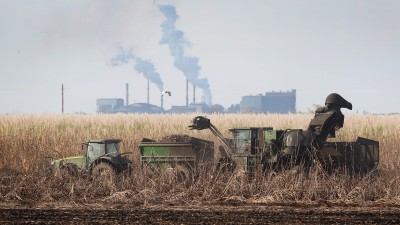
This article appears as part of our series reflecting on the struggles facing the modern American farmer.
“The quality of owning freezes you forever in “I,” and cuts you off forever from the “we.”
John Steinbeck, The Grapes of Wrath
If you have read any articles written here previously, you might know how much consideration is given over to the question of how Communists might recruit the people in rural communities to our great cause. Here, we analyze that project in a bit more detail as how we can specifically approach the farmer, and how capitalism has affected those who do the important work of growing our food. It is my belief that the revolutionary spirit lives on in rural communities, if only it could be tapped, refined, and then directed towards the oppressing classes.
The Illusion of Individual Property Rights
One of the main arguments we hear against Communism is the danger presented by collective control over what capitalists consider private resources, such as the land, air, and waters of a nation. As Communists, we understand these things as public goods, and therefore only rightfully publically owned. Capitalists cannot fathom a system in which the land or resources are controlled or owned by a single monolithic entity. What they seem to ignore is that such entities already control all the public goods. They’re just not owned by the public.
“United States has undergone a transformational restructuring, from a diversified, decentralized, network of farmers and seed growers, to one in which the majority of crop production is controlled by a few industrial corporations.”[1]
Capital capture of our government will be nothing new as a concept to any Anti-Capitalist of any stripe or tendency. Even the more conservative or MAGA elements of our society understand it to one degree or another (they just blame specific politicians, rather than the system itself). What those same conservatives may find interesting, were they to give it any thought, is the way that their great fears have already been realized. So much of what we use is under the sole control of indifferent corporations and oligarchs in distance lands. It may also give heart to some in the cause for worker liberation in that it may make our transfer of control from Corporations to Communist States more easily accomplished.
“Farms are also increasingly owned by those who don’t live in the communities: often faceless multinational corporations whose primary metric of success is profit, rather than the well-being of the community or those who labor on their farms.”[2]

Corporate Capture of American Farmland
A large percent of U.S. farmland is being purchased by multinational corporations and institutional investors looking for a steady and low-risk investment. It is currently estimated that around 39% of our farmland[3] is controlled by these investor groups via “sale-leaseback[4]” arrangements in which the investor holds title to the land and the original farmer works that land for their, the investors, benefit. The farmer, needing cash, finds themselves selling the rights to their own land, after which they will rent it from the new owners. If this situation sounds similar to the ways that vulture capitalists have ripped apart legacy corporate entities like Sears[5]&[6] and Toys-R-Us[7], it should be no surprise, as the system was conceived by the same people. It should also seem familiar to those who have studied the history of feudalism, as an ever dwindling group of elite come to own all the land, while those who once controlled it are reduced to serving those elite. As a nation (or world), we have seen this play many times, yet our attachment to capitalist values prevents us from learning anything from it.
I had a personal experience with this during a summer while in high school. I had a job building crop irrigators. It was hard work with 16 hours days broken by one 15 minute break[8]. During one build, the farmer brought a man to watch us work who had flown in that morning from Arizona. I learned that although the farmer’s family had been working that land since the 1920’s, it was now owned by the well-dressed overweight man filming us as we crawled over his new $500,000 machine. I discussed this in a previous article[9], but I at that time I left out the wide smile that man wore or how openly aroused he was by our work.
Monopoly of Seed & the Death of the Co-op
Even the two-thirds[10] of those of farmers and ranchers who still work their own land are still under the thumb of large capitalist interests, as market access is in the hands of the same institutional investors buying up all their property. The Co-Op model that farmers long relied on has fallen out of favor due to the rising costs that larger groups can offset with the economies of scale and market cornering[11], as well as lack of organizational capacity. Corporations such as Cargill and Archer-Daniels-Midland (ADM) dominate the global markets and are often capable of setting their own purchase prices, which can only be countered by groups with an equal price negotiating position such as large corporate groups, and certainly not your average family farm. Under this system, farmers have been sued for millions[12] (often ultimately paid for by selling land) because they did not use the genetically modified seed that they were contractually obligated to using, or because they engaged in so-called “Seed Piracy[13]”, meaning they saved seeds from previous years rather than bought new seed from the monopolies that sell it. Most of the time, such devils bargains are the only way for a farmer to get any seed at all.
“The future of agricultural research at America’s land-grant institutions belongs to biotech conglomerates like Monsanto”[14]
Even seed bought from Land-grant universities, once used by many farmers as an alternative to corporate sources, has come under corporate control. The fall of university funding now means that they look elsewhere for the funds necessary for their research, which means that the people we spend public money to train are working for corporations in the labs public money has built, all so corporate giants can take that knowledge for themselves in the form of seed patents that do not seem to expire[15]. Even our public institutions are agents of private capital[16].
Made to Fail
It is not only the seed monopolies that have taken away the independence of farmers (they have also bought up the traditional seed companies to own a greater share of the market[17]), but the equipment necessary for their work is no longer under their control. As with much of the machinery we use in everyday life, farm equipment now comes with clauses in the purchasing contracts that prevent farmers from repairing or modifying their own gear, despite condemnation from weakened government bodies[18], while breaking down more often than previous models[19]. Further exacerbating the problem is that so often a problem is found only when the equipment is needed most, such as during harvest season, and delay at such times can mean the difference between a good harvest and bankruptcy[20].
“Farm debt, at $416 billion, is at an all-time high. More than half of all farmers have lost money every year since 2013, and lost more than $1,644 this year. Farm loan delinquencies are rising.”[21]
This all is also to say nothing of the fact that many farmers have taken loans against their property to such a degree that for all intents and purposes, their land is now owned by the banks in the form of liens (or the government if they used an FSA loan[22], with a $600k max[23]). As anyone who grew up in a rural area will likely know, farmers don’t make much money, but they do get a lot of credit to purchase what they need between seasons[24] (in addition to often working non-seasonal jobs to further offset the balance). And while many have been able to leverage this extensive credit into raising themselves to the status of local land barons in their own rights[25], it’s a rare farmer that isn’t praying for the right weather conditions and a good harvest[26], lest they be forced to become renters on the land they’ve worked for generations.
“The works of the roots of the vines, of the trees, must be destroyed to keep up the price, and this is the saddest, bitterest thing of all.”[27]
– John Steinbeck, The Grapes of Wrath
What all this means is that U.S. farmers, as much of the rest of the resource producers, are already collective under the control of faceless corporations[28] which rather than having the interests of socially useful food production in mind, are instead interested only in the production of capital. It is a return to the time of The Great Depression, when fields were left barren or crops left to rot in so that the food be sold at a higher cost[29]. This will remain the case for as long as the interests of the farmer, both large and small or independent and corporate, are determined by the goals of capitalism. Even the smaller co-op system that was popular running up to the 20th century[30] was developed on the idea of getting better prices for the product of the land than feeding people. The system of capitalism has created a system in which those who work the land are already accustomed to following dictates from a central authority, but the disfavoring of farmer cooperatives have switched that authority from one they themselves had a part in to one in which decisions are made by the stock market (or those that control it). As is so often the case, the capitalist system itself has created the structure by which it can be destroyed, if the farmers can be awakened to the causes for their predicament. Given the events of the current administration, in which aggressively reactionary politicians in the modern GOP have destroyed previous trade deals with the largest importers of U.S. crops, such as China[31], while rising costs due to capitalist greed squeezes away what small profits our farmers manage to receive, the ground is fertile for radicalizing the farmers against their class enemies[32].
Individually, the personal interests of the farmer is the same as those of all the working class, being the basics of home, food, and the leisure that comes from living in a peaceful society. This sets the individual farmer apart from such a class of people as the Kulaks under Lenin, who burned their crops rather than see them distributed to the feed the nation. Farming isn’t a job people get in to with the idea that they will someday be rich from it, but one taken on by those with a connection to the land and community.
Solutions
There have been a number of historical mistakes in the way that Communists have approached the issue of farmers (or “peasants”, for the Bolsheviks), oftentimes considering them part of the petty-bourgeoisie and class enemies to the cause, or refusing to allow them to work the land in the way that they choose in the interests of central control[33]. These are mistakes that we cannot afford to replicate.
As with most things, a balance must be achieved between extreme points of view. On one side we have the acknowledgement that the land of a nation rightfully belongs to the people of that nation as a whole, rather than any one individual or family that lives upon it. In contrast to this idea is the attachment many of those people have to that land and the distinctly American belief in private property being one of the primary rights of an individual. There also needs to be a balance between the goals of the nation in feeding people and the goals of the farmers of materially gaining from their work[34]. None of these goals are mutually exclusive, but they must be considered fully in any proposal a new Communist regime makes in agricultural development.
Familiar Knowledge of the Land
In the area of familial attachment, there are actually good reasons for those who work the land to be given some degree of control over how that land is worked or what crops are grown there from year to year, especially if the decision is not based on any profit motives. There are distinct differences in soil, nutrient content, and weather patterns that central planning is ill equipped to account for, but those who work the land know as a matter of course. One of the mistakes made in previous Socialist experiments was national planning groups forcing farmers to grow crops based solely on the needs of the nation rather than the abilities of the land itself. Such mistakes often created famines and raised anti-Communist resistance in those communities.
The fact that American farms are already collective under the nominal control of capitalist groups will be of great benefit to any new Communist state, as the work of centralizing the production has already been accomplished. Now, we must only take control of the few seed production and crop processing facilities rather than the farms themselves, and the farmers would experience greater freedoms than then have now, as new cooperatives are established with each farmer having a greater voice in the working of their local committees.
The removal of the need for profits and the assurances that each person will have their needs met will also allow farmers to more often leave fields fallow[35] in order to allow them to recuperate the soil nutrients[36]. Doing so can also help decrease environmental damage[37] and encourage wildlife development. This is another place where Communist theories of central planning may be useful for a system of farming, as a large organized central body can better track chemical use across the whole of the nation and how it’s affecting the environment, all the better to inform the local cooperatives in how they can mitigate any damage. Farmers themselves would no longer be reliant on crop yields for their livelihoods or keeping their homes, as is currently too often the case.
Private/ Public Land Use
As we have seen throughout history and in to the current age, dogmatic adherence to Marxist values[38] can often be a detriment to the overall goals of providing for the people. One example of this is the extreme ideologically driven mistakes of the Khmer Rouge in attempting to expand their crop production with more manpower, rather than wiser decision making. One might compare this to the program developed in Vietnam, where the land is held in common by the state[39], but with sections granted to all rural residents for their own private use. As part of this plan, each rural resident is granted around 2 acres for their own private use under a “lease”, normally given over to food or specialty production. However, many individuals, especially those not familiar with farming or who live outside Vietnam, sublease their allotment to private firms, including foreign capitalist groups. These groups are regulated to ensure that their use of the land is in keeping with the plans set by the local (communal) & national committees. This way, the profits and other benefits of the land goes almost exclusively towards the person it was allotted to and the people, rather than the subleasing corporations. This system may be seen as a betrayal of strict Marxism by many, but it remains a truth that there can be no true Communism anywhere until there is Communism everywhere. For the world in which we live is too interconnected to go back to living in the previous ways. The Vietnamese cooperatives demonstrate a method of combing the need for national trade of goods and industrial methods while maintaining proletariat control over production[40].

Government Sponsored Co-Ops & Machinery
Cooperatives (co-ops) are not a new concept to U.S. farmers, as they have been used throughout our history, and indeed the history of farming in general and often as a response to increasing power of capitalist interests[41] or to take advantage of bulk discounts to supplies. A new Communist system would expand these co-ops to include motor pools for costly heavy equipment (bought by the state) and to incentivize local participation in harvests, such as the programs Soviet schools used for a time in having students help bring in the harvests that required non-mechanical labor[42].
Currently, because many farmers do not have the money to invest in their own machinery, much of the wheat harvests are brought in by custom cutters who travel across the U.S. in routes that take them from Texas all the way up to the Canadian border in a race against the summer storms (and each other). Custom harvesting is grueling work requiring long hours and lax regulation of labor laws. It is also expensive for the farmers and not logistically efficient, as the crews move their equipment over long distances year round. There is a reason many large operations do not rely on custom harvest crews, and instead invest in their own machinery, as it reduces the risks of missing the best time for a harvest or other dangers in the use of such crews[43]. A joint state provided motor-pool provided to co-ops would offer similar benefits, and could relieve some of the gruel experienced by harvester crews. We have the technology and productive capacity in the U.S. for such grand projects, yet capitalist interests prevent us from leveraging such capacity for the betterment of the people.
Conclusion
It is apparent that we are much better situated in having an ability to move away from privatized farming than our predecessors, and mostly due to the actions of capitalists in their need to concentrate their power and maximize their wealth extraction. We can take advantage not only of the technological advances that have allowed less labor to feed more people, in stark contrast to the world faced by the Bolsheviks[44], but a history of collective local organizing that is somewhat peculiar to the U.S. farmer.
The greatest challenge we have is actually gaining the power necessary to implement a system that benefits all, which will be made easier by including the rural communities in our organizing efforts. If we reach out to the people who grow our food, not only will we find a community that understands the issues facing us all, but great allies in the great cause of worker liberation. We cannot ignore the truth that some of our strongest fighters lay hidden in the rural areas, waiting to be freed.
As we are the heart of the capitalist empire, once we free the farmers and leverage their knowledge for the benefit of all, we can then liberate the world itself from the ills created by capitalist control of food sources. America can truly be both free and free the rest of the World.
Update:
A response to this article may be found here. In it, the author makes several common mistakes.
- They mistake “farmer” for “landowner” when an attempt was made to clarify that most modern farmers do not own their land. A lease or a mortgage is not ownership. The bank or creditor owns the property, not those living and working on it.
- Most modern farming is Kansas is done with machine labor, in which the farmer and their families do most of the work, rather than masses of immigrants harvesting by hand. As another article in the series points out, most farmers in Kansas have informal arrangements with each other to help during harvest.
- The description of the modern farmer as closer to Lenin’s classification of “peasant” is therefore fitting, as they hover between the landowning petty-bourgeoisie and impoverishment, as even their response indicates by claiming “the farmer’s relationship to the existing order is one of desperate clinging”. This is exactly as Lenin described the peasant class.
- The issue of Settler-Colonialism was not addressed in this article because it lays outside the scope of the topic and the authors knowledge base. However, the claims made would suggest that settler-colonialism is a problem that exists mostly for the farmers in an insulting characterization or comparison of Kansas farmers to Israeli Settlers. Settler-colonialism is a problem for all those who live in the U.S., and there is no easy solution to be found in blaming farmers for occupying land.
- The response advocates a Third-Worldist view that may be inappropriate for the material conditions of the Heart of the Empire. We must reach out to the whole of the masses, rather than specific segments of it. It is such a formulaic approach that I criticized in another article.
- In total, their ignorance of the life and practices of the rural Kansas farmer goes some way in invalidating their opinions on the matter. As a group that consists of current farmers and those descended from farm stock, it seems strange being told what our own conditions are, or how best to approach radicalizing our communities from someone who does not possess the same connections to those communities as we do. We therefore take the advice given with a grain of salt while still appreciating the attempt for what it is.
References
[1] Keeping What You Sow: Intellectual Property Rights for Plant Breeders and Seed Growers. Paulina B. Jenney. University of Montana, 2022.
[2] The Struggles of Small Family Farms – Food Revolution Network. Ocean Robbins. March 21, 2023.
[3] “Who Owns Farmland” Brevante Farm Capital.
[4] Investor Guide – Farmland. The Motley Fool. Oct. 31, 2025
[5]Eddie Lampert Shattered Sears, Sullied His Reputation, and Lost Billions of Dollars. Or Did He? Institutional Investor. Michelle Celarier Dec. 3, 2018.
[6] How Sears Was Gutted By Its Own CEO. The American Prospect. David Dayen.
Oct. 17, 2018.
[7] How Private Equity Killed Toys “R” Us – In These Times. Mark Dunbar. Oct. 10, 2017.
[8] Like many, I had no concept of labor laws, & such things were not enforced anyway in due to the power dynamics between employer & worker present even today.
[9] Re-Activating Rural Radicalism, Disco Ambition. Articles. Kansas Communist Association. April 28, 2025
[10] Which suffers under the definition of “family owned”, even if that family is the worth billions.
[11] Farm groups warn of ‘deepening crises in rural America. Feedstuffs. Oct. 15, 2025.
[12] Although the trend may be changing, with farmers now bringing suit against the giants.
[13] “Keeping What You Sow: Intellectual Property Rights for Plant Breeders “ by Paulina B. Jenney. See also: Defendants Thunderbird Seed Conditioning, LLC’s and Thunderbird Commodities LLC’s 51 Motion for Summary Judgment. Magistrate Judge Michael E. Hegarty. Oct. 13, 2013.
[14] Public-university researchers get cash for studying GMOs — and the shaft for studying organic ag | Grist. (accessed 2025).
[15] See: Bowman v. Monsanto Co. – Wikipedia (accessed 2025)
[16] Two Kansas farmers sued over uncertified wheat seed | Wichita Eagle. Nov. 13, 2009.
[17] Monsanto’s Cruel, and Dangerous, Monopolization on American Farming | Vanity Fair. The Aughts. May 2008.
[18] FTC, States Sue Deere & Company to Protect Farmers from Unfair Corporate Tactics, High Repair Costs | Federal Trade Commission. January 15, 2025.
[19] Farmers Are Buying 40-Year-Old Tractors Because They’re Actually Repairable. VICE. Matthew Gault. January 7, 2020.
[20] If you’re from farm country you’ve probably seen custom cutters trying to outrun a coming storm. See: Wheat harvest racing the weather – Yuma Pioneer. July 11, 2025.
[21] American Farmers Are in Crisis. Here’s Why | TIME. By Alana Semuels. Nov. 27, 2019.
[22] USDA Farm Ownership Loans. Website. (accessed 2025)
[23] To put this in perspective, a new combine can cost upwards of $1 million.
[24] Historically this has been the case only if those farmers fit certain demographics. See: Black Farmers Have Lost $326 Billion Worth of Farmland, Study Says | Nebraska Public Media. Dana Cronin. May 19, 2022.
[25] Such as what Lenin spoke about in classifying many farmer peasants as “Middle-Peasants”.
[26] Especially since a 10% profit margin is average. America’s Diverse Family Farms: 2021 Edition | Economic Research Service. USDA.
[27]Steinbeck, John. The Grapes of Wrath. New York: Viking Press, 1939.
[28] It should be noted that Monsanto is now controlled by Bayer, an international conglomerate based in Germany with its own history of depravity.
[29] Id at 27.
[30] Although much less popular today, many examples still exist such as Organic Valley.
[31] China’s soybean buying promises welcomed, but soaring costs worry farmers | AP News. Josh Funk. Oct. 13, 2025.
[32] Or re-radicalizing, as argued previously. See: Re-Activating Rural Radicalism (at 3).
[33] One of the great mistakes made during this time was the reliance on the ideas of Lysenkoism, rather than the commonly accepted ideas of Soviet pillaging of agricultural areas as grown from Western propaganda.
[34] It must be acknowledged that even under a communist regime, work should be rewarded in some way.
[35] What are the benefits of fallow? – The Institute for Environmental Research and Education. Jen Gale. Oct. 23, 2025
[36] Environmental Benefits of Leaving Land Fallow | Live to Plant. July 8, 2025
[37] Fertilizer overuse causes many issues, such as algae blooms and topsoil pollution, not to mention the cost of making it. See: Fertilizer and Climate Change | MIT Climate Portal. Karthish Manthiram & Elizabeth Gribkoff. July 31, 2025.
[38] Or more often, a misinterpretation of those values, as with the Khmer Rouge.
[39] Vietnam land law 2013: The land law in Vietnam, Vietnam law firm. Vietnam National Assembly, No. 45/2013/QH13. Hanoi, November 29, 2013.
[40] To learn more, see: Socialist Farming in Vietnam. YouTube. Luna Oi. Sep 15, 2024.
[41] History of Cooperatives in the U.S. Univ. of Wisconsin-Madison, Center for Cooperatives. Lynn Pitman. Dec. 2018.
[42] Though often derided in the West, these programs allowed an opportunity for students to learn where their food came from & to take a break from being in classrooms, something crucially needed now (& is not unfamiliar to those of us who grew up in rural areas). See also: Back to school: Food growing on the curriculum – Wicked Leeks. Robbie Armstrong. Sept. 9th, 2022.
[43] Regulation and the Revolution in United States Farm Productivity. Cambridge University Press. Sally H. Clarke. p. 175. ISBN 0-521-52845-3. 2022.
[44] Who had to figure out ways to overcome a labor intensive harvesting process led by unruly landowners unwilling to lose power.
Leave a Reply